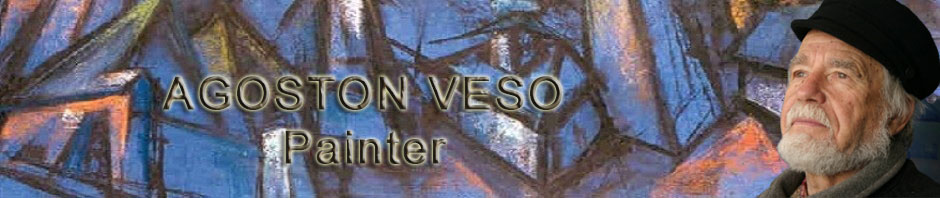
Background and Personal Goals
I attended both primary and secondary school in the town of my birth, Nagybánya (Baia Mare), then studied painting at the Kolozsvár Academy of Fine Arts in Sándor Mohy's class, graduating in 1955. Earlier on I had been attracted to sculpture; it was as a student of sculpture that I submitted a painting to the first exhibition I participated in, the 1953 Nagybánya Regional Exhibition. That painting attracted the favourable attention of my professors, and I was encouraged to continue in that medium.
In 1956, I gained membership in the Romanian Fine Arts Society, and from then until 1990 I worked as an art teacher. Besides painting, I have been interested in the theory of teaching, artistic pedagogy, and the age-old question of whether art can be taught at all. Apart from the brush and canvas, I often resort to the camera to record the extraordinary people, landscapes and monuments of the region.
Being native to Nagybánya has had a fundamental influence on my outlook. Through first-hand knowledge of my predecessors' art, I have consciously identified with "Nagybánya" and have attempted to apply that spirit and creative method — adapted to modern requirements — in light of later developments in painting.
In recruiting more and more followers from among my fellow artists and the wider public, I have sought to pass on this cultural heritage as director of the Nagybánya Painters' Colony, established by the Reformed Church in Nagyvárad.
Faithful Keeper of the Colours of Nagybánya
Ágoston Véső was born in the picturesque town of Nagybánya. At least this is how later generations have imagined this unique countryside, where the plains once competed with the mountains until playful nature composed them into a harmonious "landscape." The view from the Gothic Stephen's Tower is like two different fabrics stitched together — the bridges arching over the Szazar river — a work of human will rivalling the Creator.
Ágoston Véső was born in the year when Sándor Károly, the journalist from Arad, could still write of Nagybánya:
"This town is like a great palette. The surrounding mountains lend a delicate blue; the lush vegetation gleams in marvellous harmonies of green; blood-red roses smile at passers-by from the gardens, and the yellows, ochres, ultramarines, whites, blacks and all other colours are present too. Wherever the eye turns, it drinks in fresh colours, as though some painter drunk with joy had created this whole town in a frenzy of colour." (Letter from the Hungarian Barbizon. Vasárnap, 1931, no. 13.)
The captivating richness of the landscape, and his encounters with the steady-handed old masters — Ziffer, Mikola, Oszkár Nagy, and the "bohemian" Norbert Sztelek — all drew Ágoston Véső towards painting. The young Véső lived his entire life on — nomen est omen — Painter Street.
Upon graduating, Véső returned to a completely different Nagybánya. He came of age as a painter at a time when the reverence for nature that had characterised the generation of Hollósy and Ferenczy had long fallen into oblivion, and the clamorous post-war ideology demanded compulsory optimism in art.
In his early work, he evokes a finely observed world of landscapes and figures, sensitively following the inspiration of the Nagybánya naturalist tradition. Later, his attention turned to constructing an almost architectural structure that channels luminous yellows and reds into bold outlines. Parallel to his discovery of photography, he unearths deep archaic layers of memory manifest in the timeworn shapes of folk art — wayside crucifixes and stone crosses.
Art historian Gheorghe Vida captured the dual nature of Véső's work: "Bursting with creative energy, Ágoston Véső is an artist of Protean variability who, in spite of shifts in interpretive register, never abandons the expressive gains of his earlier vision: the rich colouration of Nagybánya landscape painting is thereby joined to a constructive rigour — with echoes of Kmetty and Feininger — and to a genuine spiritual austerity." (Cultural Centre of Hungary, Bucharest, January 2001.)
The artist never sought reward, yet he has received payment in kind: witnessing the birth of successful works by his pupils, enjoying the creative company of artist friends, and engaging in passionate debates about art — small compensation for some, a rich prize for a committed artist.
Interviews at the Centenary of the Nagybánya Artists' Colony
On Predecessors
"A whole range of factors contributed to the significance and success of the Nagybánya Colony. First and foremost, it was completely different from any other school of the day — distinct from both the Académie Julian in Paris and the Munich Academy. Its founders acted from a prophetic conviction; they were steadfast priests of art, united by a fundamental love of nature and a commitment to finding the connection between man and the natural world. To this were added extraordinary personal circumstances: a respected leader in the person of Simon Hollósy, a creative community, and the support of the town's leadership. Moreover, the townspeople embraced the artists so warmly that it soon became perfectly natural to see painters at work everywhere, and paintings began appearing not only in middle-class homes but in the houses of miners too. The artist became a member of the family… And finally — though perhaps this should have come first — there was the landscape, the genius loci, which is utterly enchanting and unique." (Balázs Feledy, 1996)
On Starting Out as an Artist
"In certain respects the expectations were much the same: there was no great felt difference between the 'Nagybánya spirit' and what was taught at the Kolozsvár Academy, partly because some professors there, such as Sándor Mohy, had studied in Nagybánya and incorporated something of Hollósy's pedagogical approach into their own teaching. However, there were significant differences between artistic education in Bucharest and in Kolozsvár. Bucharest was shaped by the French tradition, with its emphasis on the artistic dimension, whereas Kolozsvár stressed craft and technical mastery. A combination of the two would perhaps have been best. Kolozsvár was characterised by a certain greyness, a restrained, muted palette. I was in my fourth year when I was permitted to exhibit at the regional exhibition alongside my professors. Although I was a sculpture student, I submitted a painting — and it was accepted. That work bore the unmistakable stamp of Nagybánya: a greater modernity and boldness of colour that appealed to my colleagues precisely because it stood in such contrast to the Kolozsvár manner. This was no personal virtue; it simply came from having grown up in Nagybánya. Those vivid colours had entered my very blood." (György Szücs, 1995)
Tradition and Renewal
"For all its advantages, the Nagybánya heritage is a burden for us, because many people — especially abroad — expect us to work in the style of our great predecessors. But this expectation is absurd: time does not stand still; everything develops and is renewed, including the way an artist thinks, sees and expresses himself. It is worth noting that members of the second generation of the Colony, having acquainted themselves with the modern art movements, worked in a far more contemporary style than the founders. It is only natural that we, their later heirs, should likewise seek to draw on the achievements that have enriched the expressive possibilities of painting over the past century. In this respect too, the Nagybánya community is highly heterogeneous, with tendencies ranging from realism to abstraction. I could count on one hand those painters who love nature with an almost religious reverence, who work the old way — easel set up, eyes fixed on every tremor of light — and who, heedless of fashion, have the courage to paint only what their heart and conviction dictate. These are the vanishing Nagybánya artists who remain faithful to tradition." (Lajos Dávid, 1996)